
What Is a Postpartum Massage? Benefits and Timing

본문
What Is a Postpartum Massage? Benefits, Timing, and What to Expect
In the weeks after birth, a mother's body carries the evidence of everything it has just done. Shoulders drawn tight from hours of feeding. A lower back that has worked harder than it lets on. A postpartum massage is care shaped around exactly this, a full-body recovery massage for the body that has just given birth, not a spa hour borrowed and relabelled.
It is one of the gentler ways to feel like yourself again. And because it is so often misunderstood as a simple indulgence, it is worth setting out plainly what it is, what it can offer, when to begin, and what a good session actually involves.
What Is a Postpartum Massage?
A postpartum massage is a full-body recovery massage designed to support a new mother through the first weeks after childbirth, usually thought of as the first 12 weeks. What sets it apart from an ordinary relaxation massage is intent. The techniques, the positioning, and the pace are all adapted to a body that is recovering, with aims a general spa treatment was never designed to meet.
It is not a single method but a category of care. Depending on where a mother is in her recovery, a session might draw on Swedish massage, gentle deep tissue work, reflexology, soft abdominal massage, or techniques that support circulation and fluid balance.
None of this is new. Therapeutic massage for postpartum has been a cornerstone of recovery across cultures for centuries, woven deep into Korean sanhujori and Chinese confinement traditions long before anyone thought to write it down.
Postpartum Massage Benefits
The clearest way to understand the postpartum massage benefits is to start with what the recovering body is actually contending with. Each one answers a real, felt problem.
Easing Swelling and Supporting Circulation
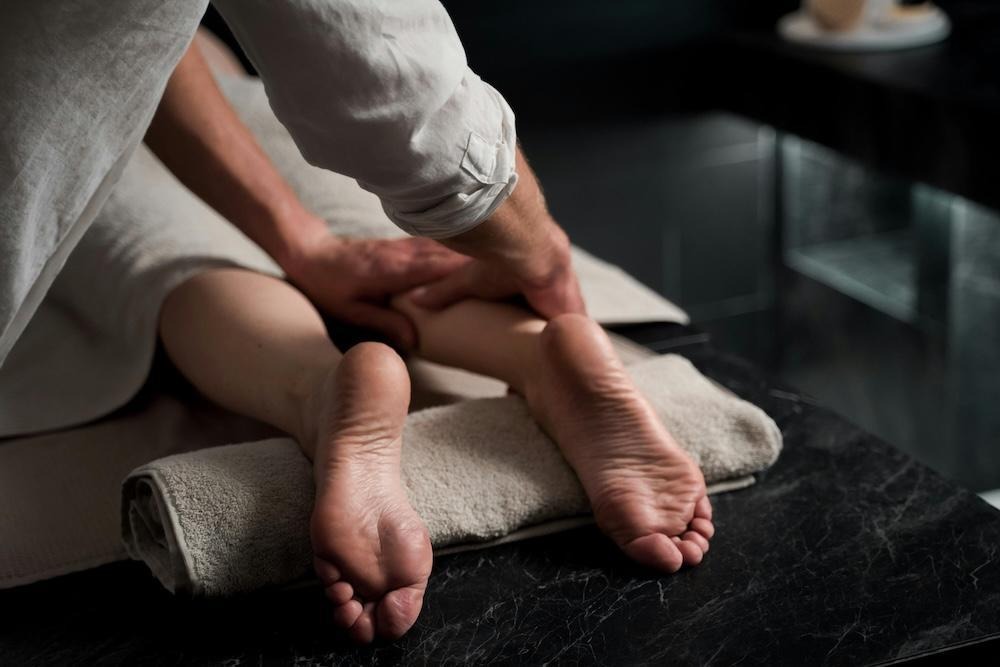
Many mothers hold a surprising amount of fluid after labour. Massage that encourages circulation helps the body move and rebalance that fluid, easing the puffiness in the hands, legs, and feet that can linger in the early days. It is one of the first changes a mother tends to notice, and one of the most welcome.
Supporting Comfortable Feeding
For mothers who are breastfeeding, gentler circulation and a calmer body can make feeding feel easier. Tension works against let-down, and a body that has been allowed to soften and rest tends to respond more readily to the rhythms of feeding. The massage does not do the work for you. It helps clear the way for it.
Feeling Steadier Through the Hormonal Shift
The early weeks bring a steep hormonal shift. Oestrogen and progesterone fall away sharply after birth, and that alone can leave mood, energy, and patience feeling unreliable. Calm, considered touch will not change the biology, but it can help a mother feel steadier and more held while her body finds its balance again.
Calm in an Emotional Time
Many new mothers know the baby blues, and some carry something heavier, including postpartum depression. Massage is not a remedy for any of that, and anything beyond ordinary low days deserves the attention of a mother's own doctor or midwife. What an unhurried session can offer is genuine calm: a quiet hour in which the body relaxes and the mind has a little room. In weeks that ask so much, that hour is not a small thing.
Better Quality Sleep
Sleep, in early motherhood, comes in fragments. Massage helps the body drop into deeper relaxation, so that the windows a mother does get tend to restore more than they otherwise would. It is less about how long she sleeps, which a newborn largely decides, and more about how deeply she rests when the chance comes.
When to Start Postpartum Massage
The question of when to start postpartum massage depends a good deal on how the birth went.
After a vaginal birth, gentle massage can often begin within the first week, perhaps five to seven days in, once a mother feels ready and there have been no complications. After a caesarean, it is usually wise to wait until the body has recovered further, often around four to six weeks, before any abdominal or deeper work. Gentle attention to the legs, arms, and upper back may be welcome sooner, with a clinician's say-so.
Whatever the path, it is worth speaking to your own doctor or midwife before beginning, particularly if the birth was complicated. As a rule, those first 12 weeks are when the body is most responsive, which is why this window is worth using thoughtfully.
What to Expect During a Postpartum Massage Session
Techniques
A session usually blends approaches. Swedish massage for general ease, gentle deep tissue work across the shoulders and upper back where feeding posture quietly takes its toll, reflexology, and soft abdominal massage to support recovery. In the earliest weeks, techniques that encourage circulation and fluid balance are especially useful for that lingering swelling.
Positioning
The familiar face-down position is rarely right for a postpartum body, least of all for a mother who is feeding or recovering from a caesarean. A therapist trained in postpartum care will usually settle her on her side, supported by pillows, and shape the session around her comfort and her stage of recovery.
Safety and the Therapist's Training
This is where the difference between a generic treatment and genuine postpartum care shows most. The right therapist knows how to work gently around a caesarean recovery, how to adapt pressure to a body that is still healing, and how to offer additional support such as postpartum binding, a practice central to traditional Korean postnatal care. Training is not a detail here. It is the whole thing. If you are looking for the best postnatal massage in Singapore, that depth of training is the question worth asking first.
Care Shaped Around You, Not Borrowed From a Spa Menu
A postnatal massage is not a luxury bolted onto recovery. It is considered care that meets some of the most common discomforts of the early weeks, the swelling, the broken sleep, the tightness, the tender emotional weather, with real intention rather than by chance.
The gap between a spa hour and specialist postpartum care is wide, and it shows in how a mother feels afterwards. At DeRAMA Singapore, a luxury postnatal care centre on the 12th floor of Artyzen Singapore, that care is delivered as authentic Korean postnatal massage in Singapore by specialist therapists brought directly from South Korea, woven into a complete recovery stay rather than offered in isolation.
If you would like to see what that looks like in practice, we would be glad to show you. Learn more about our approach, or arrange a visit to meet the therapists who would be caring for you.